Project Atlas
AI project intelligence platform (grounded RAG)
Finalist · Economic Times AI Hackathon 2.0
In simple words
Answers questions about large project documents with the exact page as evidence, and declines when it can't prove the answer.
- Recall@12
- 1.0
- Recall@12
- MRR (baseline 0.63)
- 0.75
- MRR (baseline 0.63)
- fewer input tokens
- 2.6×
- fewer input tokens
Overview
A grounded retrieval-augmented generation platform that traces each specification deviation through to its schedule and commissioning impact, citing evidence down to document, page and clause.
How it works
Key engineering decisions
Evidence gate before answering
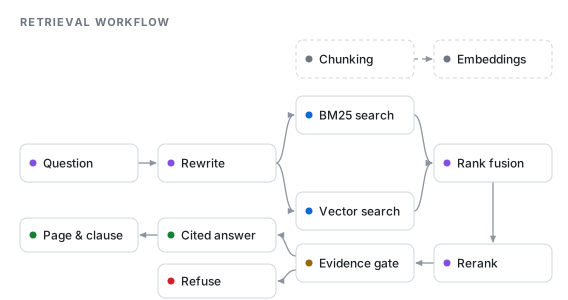
The LangGraph workflow checks whether the retrieved evidence is sufficient. If it isn't, the system refuses instead of guessing, so every answer it gives can be traced to a source.
Hybrid retrieval
BM25 catches exact terms like clause numbers; dense vector search in Qdrant catches meaning. Results are fused and reranked, which beat a baseline RAG pipeline (MRR 0.75 vs 0.63) while using 2.6× fewer input tokens.
Deterministic engines where correctness matters
Compliance checks, the CPM schedule and commissioning steps are computed by deterministic code, not the LLM, and evaluated against labelled cases.
Project-scoped access control
Three roles scoped per project, scrypt-hashed passwords and HMAC-signed tokens, with PostgreSQL as the system of record for metadata and audit logs.
What I built
- Built the FastAPI backend as layered services with project-scoped RBAC (scrypt-hashed passwords, HMAC-signed tokens, 3 roles) and SQLAlchemy/Alembic models on PostgreSQL for metadata and audit records.
- Designed the ingestion pipeline (contextual chunking, embeddings in Qdrant) and a LangGraph workflow: query rewriting, hybrid BM25 + dense retrieval, reranking and an evidence gate that refuses rather than hallucinates.
- Reached Recall@12 1.0 and MRR 0.75 (baseline 0.63) on 16 held-out questions with 2.6× fewer input tokens.
- Built deterministic compliance, CPM schedule and commissioning engines that trace each spec deviation to its impact: compliance F1 1.0 on 12 labelled cases, schedule MAE 1.5 days, 21/21 steps auto-evaluated.
- Deployed the API, Next.js/TypeScript dashboard, PostgreSQL and Qdrant to AWS EC2 with Docker Compose and Caddy TLS via GitHub Actions CI/CD; 222 backend and 22 frontend tests plus a reproducible evaluation suite.