UAV ISAC Scheduling
Learning a MILP optimiser with a Conv3D-LSTM network
In simple words
Teaches a neural network to plan what a drone does at each stop as well as a slow optimisation solver, but in a single fast pass.
- per-waypoint accuracy
- 92.9%
- per-waypoint accuracy
- joint-mode recall (from 41%)
- 75%
- joint-mode recall (from 41%)
- MILP-labelled rows
- 1M+
- MILP-labelled rows
Overview
Research at LNMIIT on integrated sensing and communication (ISAC) for UAVs: a sequence classifier that imitates a mixed-integer linear program deciding, at each of 15 waypoints, whether the UAV senses, communicates or does both.
How it works
Key engineering decisions
Solver as the teacher
Running the MILP for every trajectory is too slow for real-time use, but it produces optimal labels. A randomized generator turned it into a dataset of 66K+ labelled trajectories.
Sequence model, not per-point classifier
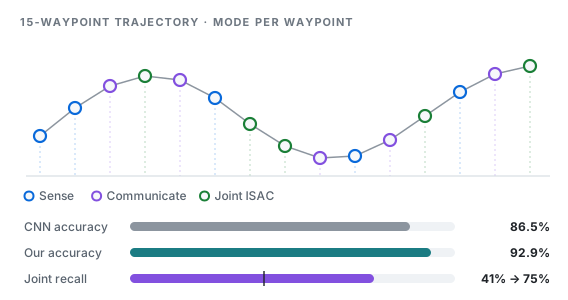
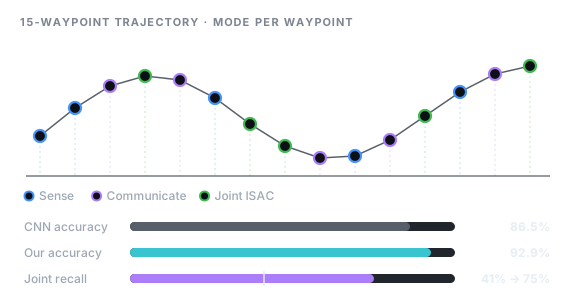
A waypoint's best mode depends on its neighbours, so a 3-branch Conv3D–LSTM reads the whole trajectory. It lifted joint-mode recall from 41% (CNN baseline) to 75%.
Judged on physics, not just accuracy
Beyond accuracy, the sensing quality (Cramér–Rao bound) and communication CDFs of the model's schedules were compared with the MILP's and track them closely.
What I built
- Extended a faculty-provided MILP (MATLAB intlinprog) into a randomized dataset generator that labels each of 15 UAV waypoints as sensing, communication or joint ISAC; generated 66K+ trajectories (1M+ rows).
- Designed a 3-branch Conv3D–LSTM classifier in TensorFlow/Keras that imitates the MILP in one forward pass.
- Reached 92.9% per-waypoint test accuracy on 60,690 unseen trajectories vs. 86.5% for a CNN baseline (joint-mode recall 41% to 75%); sensing (Cramér–Rao bound) and communication CDFs closely track the MILP.
- Co-authored the manuscript, prepared for submission to the IEEE Vehicular Technology Conference (VTC).